
The Executive AI Partner
The million-dollar employee, without the million-dollar payroll.
Silicon Valley now pays up to $1M a year for one person to diagnose where AI pays inside a business and then build it. You don’t need the hire. You just need the job done.
Conviction is not the problem.
You already believe AI matters. But you’re stuck at the starting line.
Every owner I sit down with says a version of these same things:
“Where do I even start? It gets really daunting.”
“I just don’t have that first five-hour chunk of time.”
“I’m not going to implement this unless I have mastered it, and I don’t have the time to master it.”
“I really think I’m missing out on a million dollars. So why haven’t I done this??”
None of that is a knowledge problem. You’re not stuck because you’re not smart enough. You’re stuck because you already wear one too many hats, the AI landscape moves faster than anyone with a real job can track, and there’s no obvious first step. So instead, you keep thinking about how you “really need to block off some time to figure it out” (which you won’t do), and meanwhile another quarter goes by.
The most expensive thing in your business usually isn’t what you think it is. It’s not your payroll burden; it’s not your COGS because “materials costs are ridiculous right now”; you’re looking in the wrong place. If I had to guess, the most expensive thing in your business right now is the winnable work you never chase: the jobs that don’t get bid on, the sales leads that die on the vine, the prospects you turn away because there aren’t enough hours in the day. Most people talking about AI are interested in how to make the business you have cheaper to run. But the more interesting thing to me is: how can AI enable your business to do things that you could never do before?
The journey
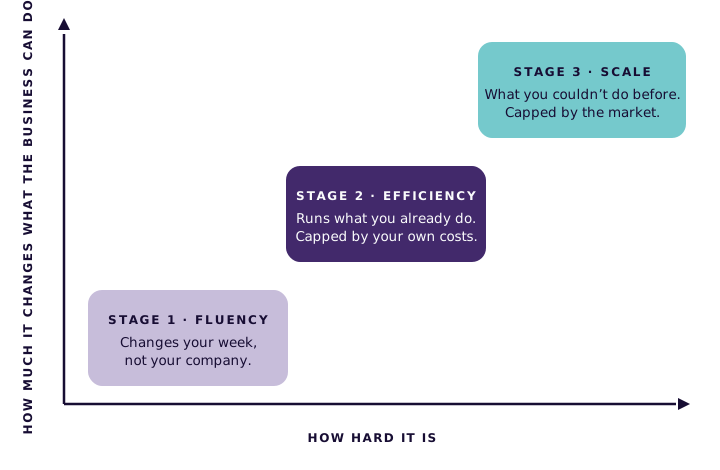
For most small businesses, the AI journey happens in 3 Stages.
STAGE 1
Fluency.
First, AI works for you personally. Drafts, summaries, a “better Google.” You get a taste of how powerful AI can be. It genuinely changes your week…and it changes nothing about your company. This is the on-ramp, not the destination; and most business owners I talk to are either stuck here or not even here yet.
STAGE 2
Efficiency.
AI takes over work your business already does: cheaper, faster, with fewer errors. AI doesn’t call in sick, and it doesn’t cop an attitude. The savings are real, and you can check them against payroll and SLAs. But they’re also capped. There are only so many costs to take out of a company.
STAGE 3
Scale.
AI enables you to capture revenue you couldn’t reach before: the bids you didn’t have hours to write, the cases that settle faster, double the clients with the same level of service. The cap is no longer your existing economics; the new cap is your TAM. And I have yet to meet the owner who has genuinely saturated their TAM.
Stage 2 savings pay for AI implementation. Stage 3 is the real reason to do it.
The full argument, with the arithmetic, is in How I Think.
What this is
Like a Fractional CFO, but for AI.
You already know you can rent senior capability a few hours at a time: the fractional CFO, outside counsel, the marketing guru on retainer. There’s a new role on that list. Big tech companies now hire full-time AI experts whose whole job is finding where AI pays inside a business and then building it; and their salaries can run over $1 million per year.
No normal small business can make that hire. But it’s fast becoming a critical role. That’s why I built Dominion AI.
I’m James Green, and I do that $1M job for owner-operated businesses, one manageable slice at a time: from a $2,500 diagnostic to a $10,000-a-month standing engagement.
1. Start small. Scale what works.
The engagements below are the same relationship at different sizes: a two-week diagnostic, a 90-day install, ongoing support. You buy as much support as the business needs, and I’ll be right by your side identifying and implementing the biggest AI wins in your business.
2. You end up independent.
The danger of using outside consultants for something as business-critical as AI is that you can become dependent on them. Every system I help you implement ships with detailed video and written documentation, and I train your team as it’s built. I make sure that whatever we build runs without you depending on me.
3. Someone owns the outcome.
Most AI projects die as slide decks or pilots because nobody is accountable for finishing. I am; and I guarantee it. If your project isn’t complete within the bounds of our engagement, I keep working for free until it IS done.
The engagements
Engagements for every stage of your AI journey.
I hate being sold to, and so do you. As such, I don’t have any sales tactics to deploy on you. The rate card is published because there’s nothing to negotiate. And you can buy right now with your credit card instead of “Talk to Sales.”
Most clients begin with the Audit and decide about the rest once they’ve seen their results.
Fee schedule
as of July 2026
| Step | Engagement | Price |
|---|---|---|
|
01 Diagnose |
AI Leverage Audit In two weeks, I deliver The Leverage Map: an assessment of where AI pays in your business, what each opportunity is potentially worth, and what to build first. I give you the full roadmap, and you don’t need me to implement. |
$2,5001 |
|
02 Install |
90-Day AI Operating Sprint Over 12 weeks, I guide you and your team to implement the highest leverage system from your Map. Live in production in 90 days or I keep working free. |
$4,500/mo × 32 |
|
03 Advise |
AI Advisory Retainer A monthly working session to help you keep implementation momentum, from an advisor who already knows your business. Async access to me any time. |
$2,500/mo3 |
|
04 Execute |
The Executive AI Partner Done-for-you implementation where I build the systems. Quarterly onsite strategy days. Board or shareholder presentations delivered by me any time you want them. Only 5 concurrent slots available: first come, first served. |
$10,000/mo4 |
1 $2,500 up to 25 employees; $3,500 from 26 to 50. The net unrefunded Audit fee credits toward the Sprint when the Sprint agreement is signed and its first invoice or pay-in-full balance is paid within 30 days of your Audit readout.
2 Pay in full: $12,500. Four concurrent Sprint slots; when they’re full, you’re booking the next cohort.
3 Sprint graduates only.
4 Quarterly commitment. Invitation or application only; there is no buy button.
The guarantees
If it doesn’t work, you don’t pay.
My intention is always to underpromise and overdeliver. If you don’t get at least what I sold you, you should get your money back.
The 10× Map Guarantee
If the Leverage Map doesn’t identify at least ten times your audit fee in annual savings and new revenue opportunities, I refund the whole fee and you keep the map anyway.
Live in 90 or I work free
You show up to the Sprint sessions and do the assigned work. If there’s no working system in production by or before day 90, I keep working at no charge until there is.
Off the fee schedule
Your own AI chief of staff, deployed and maintained by me.
This one isn’t an engagement, and it isn’t a fraction of the seat; that’s why it isn’t in the table above. It’s a subscription: a managed agent, tailored to your business, that carries real work for you every single day. And it’s openly an agent. I will never pretend a human did the work; what you get instead is a human accountable for it.
That human is me. I review what your agent produces, I improve it month over month (because I’m paid to), and when you catch yourself asking “could it also do this?”, the answer is: ask me, and I’ll make it happen. Compare it to a hire, not to the $200-a-month AI tools. It does real work, and someone with a name answers for the output.
$2,000
per month · plus a $500 one-time onboarding fee
Month to month; cancel any time. Cancel within the first 30 days and I refund 100% of your subscription fee (the onboarding fee is the one thing I keep).
Dominion AI runs on the same systems I recommend.
My advisory practice is a live demo: when you interact with my business, whether you know it or not, you’re experiencing the results of the same AI technology I’m going to help you install in yours. I have put AI tools through their paces on my own business before I’ll ever recommend using them in yours.
Dominion AI is for you if:
- You run a company between $1M and $20M in revenue, roughly 3 to 50 people, in any industry.
- You already KNOW that AI is a big deal, but you have no idea what to do about it.
- You will spend $100 to make $1000 all day long.
- You’re kind and gracious, to your team and mine. I have a very firm “no assholes” rule: absolutely no exceptions. :-)
- It’s especially for you if you would also adopt the Dominion Credo: “I believe that faithful entrepreneurship and operational excellence is my biggest lever for the Kingdom building to which I’ve been called. I believe I can transform industries, serve communities, and advance God’s purposes in the world by using my God-given talents in the marketplace.”
Not a fit if: you want someone to sell you vaporware, manufacture a million hot leads out of thin air, or herd your cats.
Don’t let another quarter pass you by.
Get started with AI using the Leverage Map. Install the best opportunity on it, live in 90 days. Rinse and repeat until the bottleneck in your business is one you chose: too many open opportunities, too many good hires in the HR pipeline, too much sold work to fulfill. The companies pulling ahead with AI a year from now are the ones getting started today.