
The AI Leverage Audit
A hundred possible AI projects.
Two weeks to know which ones pay.
A fixed-scope, fixed-price diagnostic. I interview your leadership, my AI interviews your entire team the same afternoon, and you get the Leverage Map: where AI pays in your business, what each opportunity is worth, and what to build first. You get the full roadmap, and you don’t need me to implement it. It is not a sales call with a costume on.
Includes the 10× Map Guarantee (details below).
Why an audit first
Building the wrong thing can be a very expensive mistake.
You’ve seen the LinkedIn posts and the YouTube videos. You know AI can help somewhere. The hard part is knowing which of the hundred possible projects is worth real money and which one burns three months for nothing. Most owners either guess or stall.
The Leverage Audit exists so you can do neither.
Most AI assessments also stop at half the question: how can AI make my business more efficient? Saving money with AI is real, but it's often the smaller and less exciting half.
What gets me more excited is finding the ways AI can help you capture revenue you can't today: the jobs you don't have time to bid, the grant applications you don't have time to write, the sales inquiries that grow stale, the clients you turn away because you can't deliver.
The audit seeks to identify and quantify both.
What happens
Two weeks → One Map.
Day one
Step 1:OOwner deep dive (90 minutes).
A working session with you where I'll help you brain-dump, think out loud, and think big. No prep required on your end. I bring the questions, including ones you may never have asked.
When you schedule an Audit, I'll send you the optional AI Leverage Audit Companion: a one-hour guided prep session. Whatever you fill in helps me come armed with even better questions. Skip it entirely and nothing changes; I bring the questions either way.
First Week
Step 2: My AI agents interview your whole team.
My AI interviewer connects with every employee for a short voice interview about their work (phone call or in-browser call). Whether it's 3 people or 50, we'll interview them all. We are clear with them that it's not a performance review, and individual answers are never used to evaluate anyone.
Owners consistently tell me they’ve never seen this data about their own company. “18 of my 20 people say they wish we could fix this” is a very different conversation than "I have a hunch."
Before readout
Step 3: Systems and tooling review.
What systems you run, what tools your team actually uses, what your VAs and freelancers are doing. We often find substantial efficiency opportunities here.
In two weeks
Step 4:II present your Leverage Map.
Every notable opportunity goes on the map in one of two sections:
- The Floor: how AI can help you save money, which can often be calculated in dollars.
- The Ceiling: how AI can help you do things you've never been capable of before. This is often much more exciting, but the dollar figure is more of an educated guess.
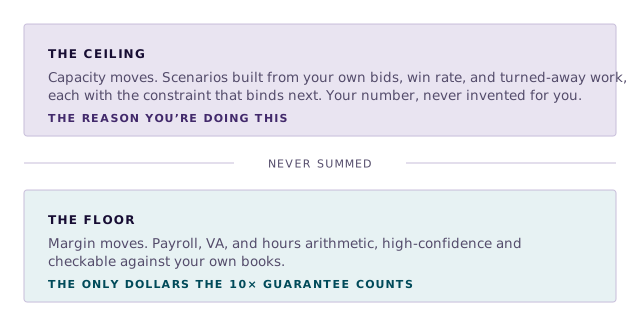
The Map also records the Day-One Baseline: things like your bids per week, close rate, cycle time, customer retention, or capacity utilization, as you or your team attest them today. That way, a year from now, “did it work?” is arithmetic instead of argument.
The readout ends with my recommended build sequence and your first Leverage Library assignments, so you walk out knowing exactly what to do and in what order.
What you walk away with
- The Leverage Map. The Floor (savings you can check) and the Ceiling (new revenue scenarios using your own numbers), ranked and sequenced. Yours to keep and act on, whether that's with me, with another consultant, or on your own.
- The Day-One Baseline. Where your business actually stands today, so a year from now “did it work?” is arithmetic instead of argument.
- The workforce-interview report. A synthesis of what your team actually said about where the friction and opportunity is "on the ground." This is a view many owners never get.
- Access to the Leverage Library™. This member toolkit comes with every engagement and contains AI prompts, toolkits, and workflows based on my best methodologies.
- A live demonstration. The AI systems I use (like the one that just interviewed your whole team, or the one that performed discovery and analysis for your Map) is an example of the same kind of system I’ll help you build. You get to experience the possibilities in action.
Pricing
Flat fee, eligible for Sprint credit
Fee schedule
effective July 2026 · all figures USD
| Company size | Price |
|---|---|
| Up to 25 employees | $2,500 |
| 26 to 50 employees | $3,500 |
Above 50 employees the Audit is out of scope as priced; start a conversation and we’ll scope it properly.
The net unrefunded Audit fee credits toward a Sprint (implementation of Audit recommendations) when you sign the Sprint agreement and pay its first invoice or pay-in-full balance, after the credit, within 30 days of your Leverage Map readout. Booking kickoff alone does not qualify. A refunded Audit fee is unavailable as credit.
The 10× Map Guarantee
If the Leverage Map doesn’t identify at least ten times your audit fee in annual savings and new revenue opportunities, I refund the whole fee and you keep the map anyway. The guarantee’s full terms and conditions are in the engagement agreement.
Common Questions
“Why isn’t this free? Everyone offers a free AI assessment.”
Because a free assessment is a sales call, and everybody knows it. This is a real diagnostic with real deliverables, priced so I can do it properly.
“Can’t my team figure this out themselves?”
Probably, eventually. What you’re buying is a shortcut past the expensive and painful part, led by someone who does this every day.
“Can’t I just hire an AI person?”
You can try. Good ones are scarce, expensive, and mostly getting hired by companies much bigger than yours. A full-time salary is also hard to justify when what you actually need is the diagnosis, the build plan, and one-time implementation. If your Map says you genuinely need the hire, it will say so, and you’ll be hiring with a plan instead of a hope.
“Are you promising growth?”
Of course not, and you should be suspicious of anyone who does. AI can capture demand you can already see being missed: the jobs you didn’t bid, the inquiries that sat, the work you turned away. It does not manufacture customers; selling that pipedream is the domain of marketing agency businesses, and you may have paid that tuition already.
“Is this a pitch for software you resell?”
No. I resell nothing and take no commissions. In fact, part of the Map’s job is telling you what not to buy.
“What do you do with our data?”
Interview transcripts and systems information are completely confidential and are used only to produce your deliverables. If you’re in a regulated business, I’ll walk through your compliance questions before the audit starts. If you'd like to complete a more extensive NDA that what my standard agreement covers before we begin, I'll be happy to.
Your Map is two weeks away.
Book the audit and the leadership deep dive goes on my calendar this week.
Questions first? Start a conversation